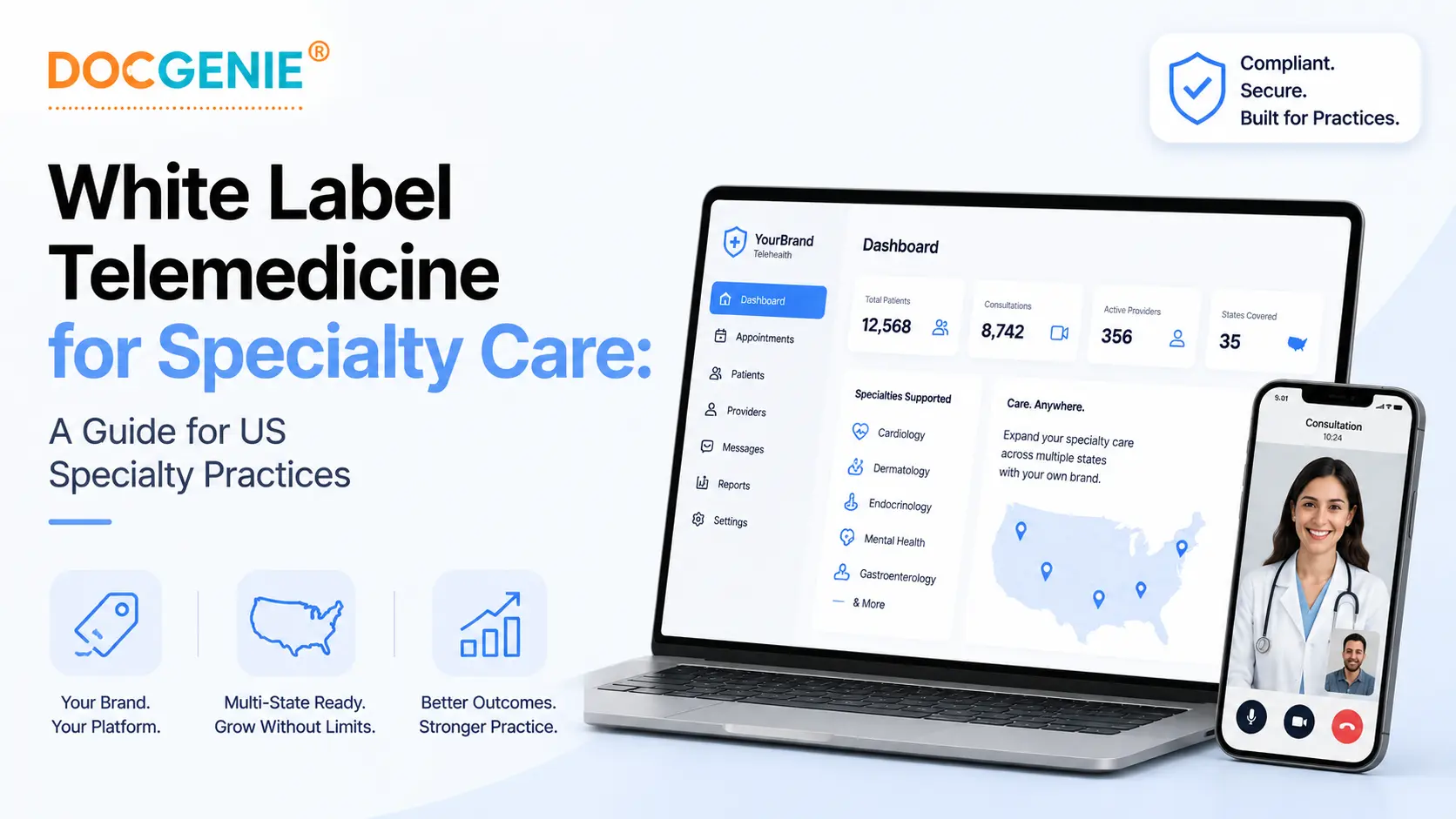
White Label Telemedicine for Specialty Care: A Guide for US Specialty Practices

Founder & Medical Director, DocGenie Global · MD (Family Medicine) · USC California · 30+ years of experience
Table of Contents
Introduction
White label telemedicine for specialty care requires platform flexibility that general telehealth tools rarely provide. Each specialty has a distinct consultation model, patient journey, and workflow integration need — dermatology relies on visual assessment, mental health requires session privacy and therapeutic continuity, chronic care depends on recurring engagement, cardiology follow-up needs structured clinical documentation. A configurable white label telemedicine platform for US specialty practices accommodates these differences; a one-size-fits-all generic tool typically does not.
Dermatology Telemedicine
Dermatology is one of the highest-volume telemedicine specialties in the US because many consultations are visual — rash assessment, follow-up on treatment response, acne and psoriasis monitoring, mole evaluation. The specialty lends itself to virtual care when the platform supports the quality of visual interaction dermatologists need.
Platform requirements for dermatology telemedicine:
Cardiology Follow-Up
Cardiology telemedicine is primarily follow-up focused — post-procedure monitoring, medication reviews, chronic condition management, and risk factor assessments. Cardiology virtual care tends to be recurring rather than episodic, requiring scheduling infrastructure that supports regular check-in cadences.
Key platform requirements for cardiology follow-up:
Mental Health and Behavioural Health
Mental health virtual care places the greatest emphasis on session privacy, therapeutic continuity, and the consistency of the care environment. Patients discussing sensitive mental health history are more attuned to whether their session feels secure and private — and more likely to disengage if the platform feels unfamiliar or generic.
Specific requirements for mental health telemedicine:
See the guide to white label telemedicine for mental health practices for a full treatment of this specialty's requirements.
Chronic Care Management
Chronic care management (CCM) programmes operate on long patient-provider relationships with regular contact over months and years. Virtual care is a natural fit for CCM — removing the travel barrier increases appointment adherence significantly for patients managing diabetes, hypertension, COPD, heart failure, and other chronic conditions.
Platform requirements for chronic care telemedicine:
Women's Health
Women's health telemedicine spans a broad range of consultation types — routine follow-ups, prenatal check-ins, menopause management, fertility consultations, gynaecological follow-ups, and specialist referrals. The patient population typically has high digital health engagement and high expectations for communication quality.
In women's health, branding matters particularly because patient trust is built over long care relationships. Patients who receive booking confirmations, appointment reminders, and follow-up messages from their named women's health provider — rather than from a generic telehealth platform — experience higher continuity of care and are more likely to attend preventive consultations.
Platform considerations:
Multi-Specialty Practices and Hospital Outpatient Departments
For multi-specialty groups and hospital outpatient departments, the white label platform challenge is delivering multiple distinct clinical workflows — each with different scheduling logic, appointment types, intake requirements, and provider configurations — under a single branded interface that the patient experiences as one coherent service.
This is where white label scalability matters most. Requirements in this context:
Conclusion
The best white label telemedicine platform for specialty care is one that can be configured to fit your clinical model — not one that forces your clinical model to fit the platform. DocGenie Global's white label platform is designed to support a range of US specialty care workflows, from single-specialty practices to multi-specialty groups, with the branding, integration, and workflow flexibility that specialty virtual care requires. For compliance obligations relevant to specialty telemedicine, see HIPAA Compliance for Telemedicine Platforms.
Frequently Asked Questions
Which medical specialties are best suited to telemedicine?
Telemedicine is well suited to specialties that do not require physical examination as a primary diagnostic tool. These include psychiatry and behavioural health, dermatology (with image submission), endocrinology, neurology, cardiology follow-ups, rheumatology, oncology support consultations, and second opinion services. The suitability of virtual care for specific clinical encounters should be evaluated by the treating clinician.
How do white-label platforms support specialty-specific clinical workflows?
A configurable white-label telemedicine platform can support specialty workflows through customisable patient intake forms, specialty-specific clinical documentation templates, asynchronous image and file review capabilities, referral pathways between specialists and primary care, and provider dashboards tailored to the workflow of each specialty.
What is store-and-forward telemedicine and which specialties use it?
Store-and-forward telemedicine is an asynchronous model where clinical information — images, lab results, records — is submitted by the patient or referring provider and reviewed by the specialist at a later time, without a real-time video call. It is commonly used in dermatology, radiology, pathology, and ophthalmology, where visual assessment of submitted data is the primary clinical task.
Can a white-label telemedicine platform handle specialty-specific documentation requirements?
Yes, provided the platform supports configurable EMR templates and clinical note structures. Specialties often have specific documentation needs — for example, dermatology may require image-linked records, psychiatry may require session-specific note formats, and cardiology may require integration with remote monitoring device data. Evaluate vendors based on how readily these can be configured.
What licensing requirements apply to specialty telemedicine across US states?
Specialty providers must hold a valid medical licence in the state where the patient is located at the time of the encounter. Some specialty boards have additional guidelines on telehealth practice. Providers practising across multiple states should review state-specific telehealth laws and consider the Interstate Medical Licensure Compact if they qualify.
Related Articles
White Label Telemedicine for Mental Health Practices: A Complete Guide