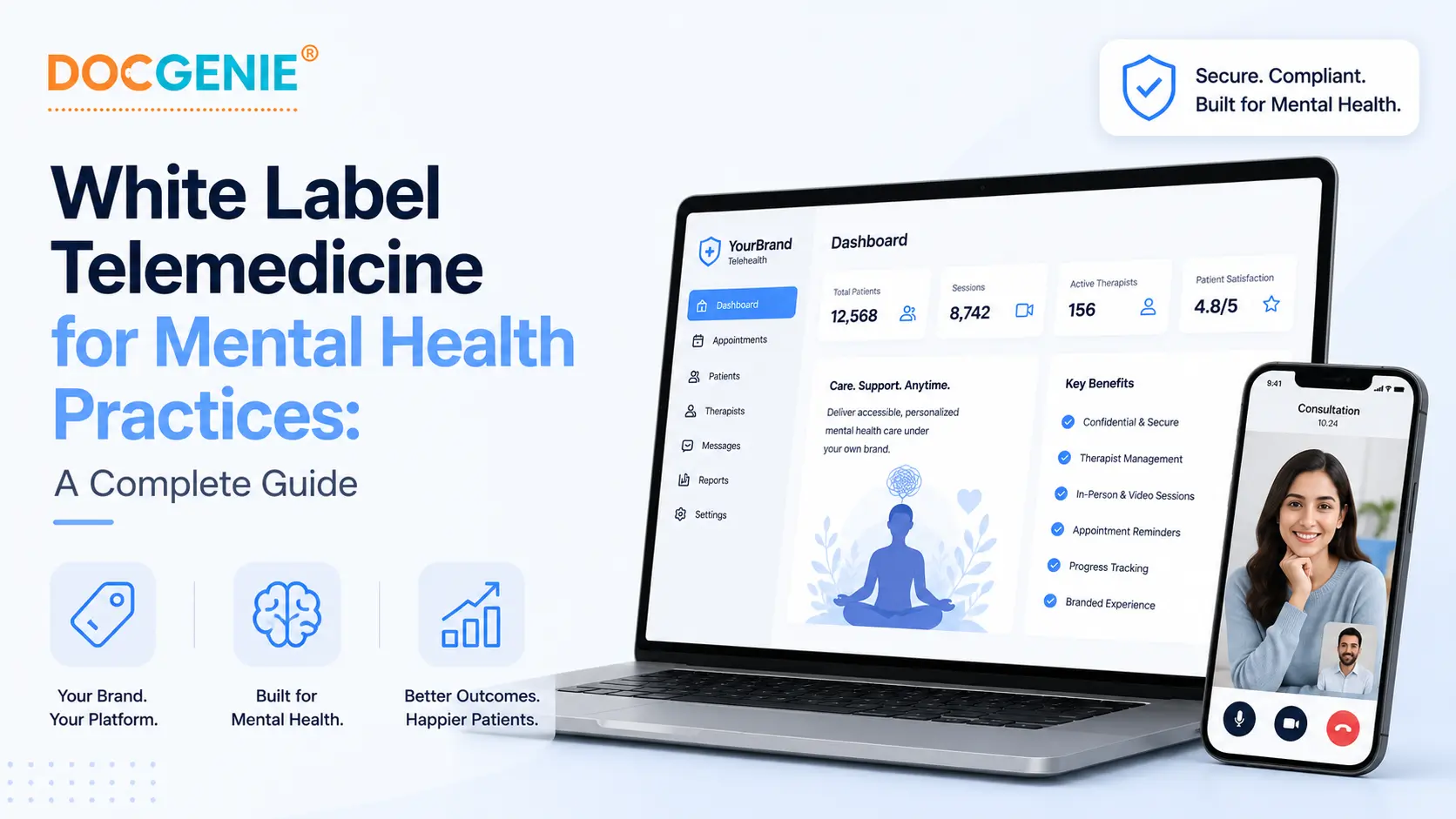
White Label Telemedicine for Mental Health Practices: A Complete Guide

Founder & Medical Director, DocGenie Global · MD (Family Medicine) · USC California · 30+ years of experience
Table of Contents
Introduction
A white label telemedicine platform for mental health is a fully branded virtual care solution — your practice name, your domain, your patient portal — that mental health practices, behavioural health organisations, and therapy groups use to deliver therapy, psychiatry, and counselling online. Unlike general telehealth, mental health virtual care has specific requirements around session privacy, therapeutic continuity, and the psychological safety of the care environment that make branding particularly important.
Why Mental Health Virtual Care Has Different Platform Requirements
Mental health consultations are sensitive in ways that general care consultations are not. Patients discussing trauma, psychiatric symptoms, or personal mental health history need to feel their session is private, secure, and within a trusted clinical environment — not mediated by a generic third-party app they have never heard of.
For the practice, the platform requirements reflect this sensitivity:
Why Branding Matters More in Mental Health Than Most Specialties
In mental health care, the therapeutic relationship is the treatment. Patients who feel they are within their trusted provider's environment are more likely to engage honestly, keep appointments, and continue with care over time.
A white label telemedicine platform keeps your practice brand consistent across every patient interaction. Patients see your practice name, your logo, and your domain — not a third-party platform. This matters because:
This is not cosmetic. In mental health care, the consistency of the care environment is part of the therapeutic experience.
Core Platform Capabilities for Mental Health Virtual Care
When evaluating a white label platform for mental health use, the following capabilities are specifically relevant:
Group Practices and Community Behavioural Health Organisations
White label platforms that support multiple providers under a single branded interface are particularly valuable for group mental health practices and community behavioural health organisations. Requirements in this context include:
Larger behavioural health organisations — county mental health services, multi-site community clinics, employee assistance programme providers — have additional requirements around patient volume, multi-location configuration, and administrative reporting.
Supporting the Recurring Care Model
Unlike acute care, mental health virtual care is defined by recurrence. Patients typically return weekly or bi-weekly for extended periods — sometimes months or years. The platform must support this model without creating friction that causes patients to disengage.
Features that support the recurring care model:
When every touchpoint carries your practice name — from the booking confirmation through the reminder to the post-session follow-up — patients stay engaged with your care environment. Generic platforms that redirect patients to a third-party experience interrupt this continuity in ways that are particularly damaging in mental health care.
HIPAA and Compliance Considerations for Mental Health Platforms
Mental health information carries additional protections under US law beyond standard HIPAA obligations. Psychotherapy notes receive special protected status under the HIPAA Privacy Rule — they are not part of the standard designated record set and require separate patient authorisation for disclosure.
When evaluating a white label platform for mental health use, confirm:
Mental health providers operating in certain states may also face state-specific privacy laws that go beyond federal HIPAA requirements. Confirm your vendor is aware of these obligations and can support compliant workflows in your state.
Conclusion
For mental health practices and behavioural health organisations considering virtual care expansion, the right telemedicine platform is one that strengthens — rather than disrupts — the therapeutic relationship. A white label platform that keeps your brand front and centre across every patient interaction is the most direct way to deliver that continuity. DocGenie Global's white label telemedicine platform supports secure virtual consultation workflows, patient booking, provider dashboards, and branded patient communication for mental health and behavioural health providers. See also: HIPAA Compliance for Telemedicine for US-specific compliance guidance relevant to behavioural health practices.
Frequently Asked Questions
What is white-label telemedicine for mental health practices?
White-label telemedicine for mental health is a branded virtual care platform configured for the specific workflows of therapy, psychiatry, and behavioural health services. It allows practices to offer secure online consultations, session notes, scheduling, and patient communication under their own brand rather than a generic app.
What clinical features does a mental health telemedicine platform need?
A mental health telemedicine platform should include secure HIPAA-aligned video consultations, a clinical documentation system for session notes, appointment scheduling with reminders, patient intake forms, secure messaging between sessions, and role-based access controls for therapists and admin staff.
Is telemedicine effective for therapy and mental health counselling?
Clinical research has found telehealth delivery to be effective for a range of mental health conditions including depression, anxiety, and PTSD for many patients. The American Psychological Association recognises telepsychology as a viable care delivery model. The suitability of telehealth for individual patients should always be assessed by the treating clinician.
How do mental health telemedicine platforms protect patient confidentiality?
Platforms designed for mental health care use end-to-end encryption for video and messaging, role-based access controls so only authorised staff can view patient records, HIPAA-aligned data storage, BAA agreements with the vendor, and audit logs for all data access.
Can group therapy sessions be conducted via telemedicine?
Yes, many virtual care platforms support multi-participant video sessions suitable for group therapy. Platforms should be evaluated for group session capacity, participant privacy controls, and the ability to manage waiting rooms, session recordings, and group-specific access permissions.
Related Articles
Why Your Telemedicine Platform's Branding Matters More Than Its Features