Why Your Telemedicine Platform's Branding Matters More Than Its Features

Founder & Medical Director, DocGenie Global · MD (Family Medicine) · USC California · 30+ years of experience
Table of Contents
Introduction
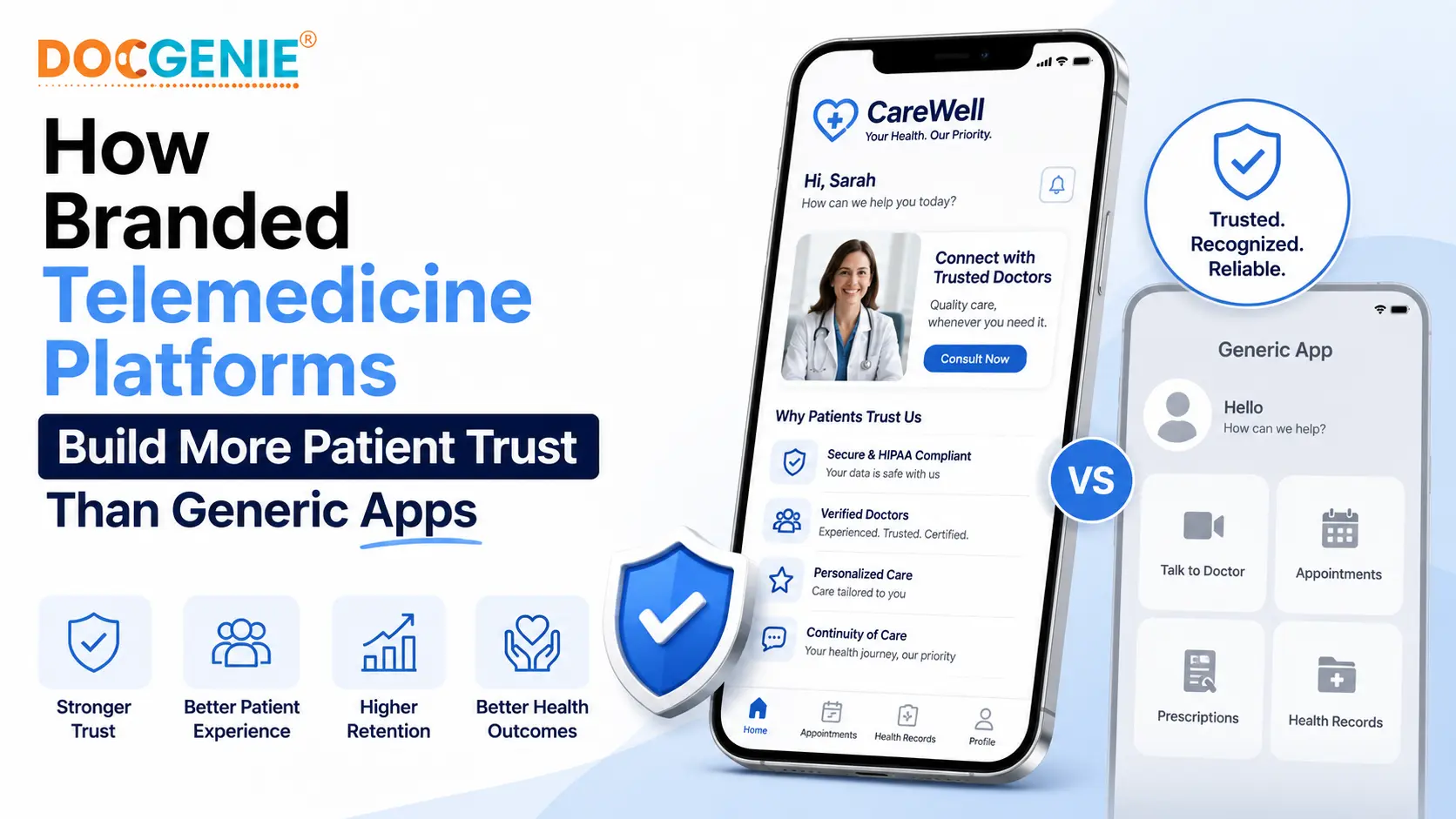
Telemedicine branding directly affects patient trust, adoption rates, and retention. When patients encounter a third-party platform instead of their provider's branded environment, research on digital healthcare behaviour consistently shows higher rates of booking abandonment, lower appointment completion, and reduced likelihood of rebooking. A white label telemedicine platform keeps patients within your brand's environment across every touchpoint — and that continuity has measurable effects on both patient experience and clinical outcomes.
The Trust Gap in Generic Telehealth
When a patient books a virtual consultation through your practice and is redirected to a page showing "Powered by [Third-Party Platform]" — or worse, an entirely different domain — something important breaks in the patient experience.
The patient is no longer in your care environment. They are in someone else's.
For routine digital services, this brand transfer is minor friction. In healthcare, where patients share sensitive personal and clinical information and where the therapeutic relationship is foundational to treatment outcomes, the stakes are different. Patients who arrive at an unfamiliar third-party interface before a consultation are:
The platform your patients see is part of the clinical experience — not separate from it.
What Patients Experience With Generic Platforms
Generic third-party telehealth platforms create what could be called a brand handoff — the patient leaves your practice's environment and enters a platform that belongs to someone else. In this model, several dynamics emerge that erode the patient-provider relationship over time:
Each of these effects compounds over time. Practices that use generic platforms for virtual care often see lower telemedicine adoption rates than those using branded platforms, not because of feature differences, but because of the trust gap.
What White Labeling Actually Changes
A white label telemedicine platform means patients never leave your brand's environment. From the moment they receive a booking confirmation to the moment they join the video consultation and receive a follow-up message, every touchpoint carries your logo, your name, and your domain.
This is not a cosmetic distinction. It changes the patient's psychological frame throughout the care journey:
The practical result: patients stay more engaged, complete appointments at higher rates, and are more likely to return for follow-up care. Their trust is in your practice, not in a platform.
Brand Continuity as a Clinical Advantage
The clinical implication of brand continuity is often underappreciated in technology purchasing decisions. Patients who feel consistently connected to their provider's brand across in-person, virtual, and follow-up touchpoints are:
No-show rates are one of the most measurable effects. Branded reminder communications — sent from your practice name rather than from a generic platform — consistently show higher open rates and lower no-show rates than generic platform reminders. In a practice where each missed appointment represents direct revenue loss, this difference compounds quickly.
Why Features Are Table Stakes
When healthcare providers evaluate telemedicine platforms, the feature comparison typically dominates: video quality, scheduling tools, EHR connectivity, mobile experience. These are real and important requirements.
But among established platforms, these features are increasingly table stakes. Multiple vendors offer reliable video, scheduling, and EHR connectivity. What differentiates the patient experience — and what drives adoption and long-term retention — is whether patients feel they are within their trusted provider's environment or navigating an unfamiliar third-party interface.
For providers who have spent years building patient relationships and practice reputation, a white label platform protects and extends that investment into virtual care. A generic platform uses the trust your practice has built to deliver patients to someone else's environment.
What a Fully Branded Telemedicine Experience Covers
A complete white label telemedicine patient experience extends across every touchpoint in the care journey:
When every one of these touchpoints is consistent, the patient's experience is coherent. When they are inconsistent — some branded, some not — the gaps erode the trust that makes healthcare relationships work.
Conclusion
Telemedicine branding is not a cosmetic decision — it is a patient experience decision with measurable downstream effects on adoption, retention, and satisfaction. The providers who treat branded telemedicine as a trust-building tool, rather than a technology purchase, are the ones who see the strongest patient engagement with their virtual care programmes. See also: Patient Retention in Virtual Care for a deeper look at how branding affects long-term patient relationships.
Frequently Asked Questions
Why does branding matter in telemedicine?
In virtual care, patients have less of the physical environment — the clinic, the waiting room, the staff uniforms — to anchor their trust in the provider. The digital interface becomes the primary representation of the organisation. A branded, professional virtual care environment reinforces the provider's identity and reduces the cognitive friction patients feel when switching to online care.
How does a branded telemedicine platform build more patient trust than a generic app?
When patients interact with a care platform branded to their actual provider — with the right logo, domain, and communication style — they remain within a familiar relationship rather than being handed off to a third-party app they do not recognise. Consistency between the physical and digital brand strengthens the patient's sense that they are receiving care from an organisation they already trust.
What branding elements can be customised in a white-label telemedicine platform?
Most white-label telemedicine platforms allow customisation of the logo, colour scheme, custom domain name, email and notification templates, patient-facing language, appointment confirmation messaging, and the overall look and feel of the patient portal and provider dashboards.
Is there a measurable difference in patient adoption between branded and generic telemedicine?
Healthcare providers that deliver virtual care under a recognised brand typically report higher patient adoption rates compared to those directing patients to generic third-party platforms. Patients are more likely to register and return when the digital experience clearly belongs to the provider they already have a relationship with. NEEDS SOURCE / HUMAN REVIEW: specific adoption rate figures should be verified before publishing.
Does branding affect patient retention in virtual care?
Yes. Patients who consistently interact with a branded care portal are more likely to rebook through the same provider rather than searching for alternative services. The branded environment keeps the provider's identity prominent at every touchpoint — booking, consultation, prescription, reminders — which reinforces the long-term patient relationship.
Related Articles
White Label Telemedicine for Mental Health Practices: A Complete Guide