White Label Telemedicine Platform Pricing: A Guide for US Healthcare Providers

Founder & Medical Director, DocGenie Global · MD (Family Medicine) · USC California · 30+ years of experience
Table of Contents
Introduction
White label telemedicine platform pricing is structured around what your organisation actually needs — provider count, integration depth, branding scope, and support tier — rather than a single flat rate. For US healthcare providers, understanding how vendors structure pricing, what drives cost up or down, and how to compare the total cost against in-house alternatives is the starting point for a useful vendor conversation. This guide explains how pricing works and what to expect.
How White Label Telemedicine Vendors Structure Pricing
White label telemedicine platforms typically price in one of four ways:
Per-provider subscription: A monthly or annual fee per clinician using the platform — commonly $100–$500+ per provider per month, depending on the platform and feature tier. Predictable at small scale; can become expensive for large provider networks.
Platform licence fee: A fixed monthly or annual fee for the platform itself, regardless of provider count. More common for larger organisations. Can be significantly more cost-effective when you have many providers who would each trigger per-seat charges.
Revenue share: A percentage of each consultation fee goes to the platform vendor — typically 5–20% of consultation revenue. Common in consumer telehealth marketplaces, less standard for white label enterprise deals where the organisation wants full commercial control.
Custom enterprise pricing: For health systems, large multi-specialty groups, and digital health companies with complex requirements, pricing is typically negotiated based on scale, integration scope, branding requirements, and support model. Ranges vary widely — from tens of thousands annually for smaller organisations to hundreds of thousands for large systems.
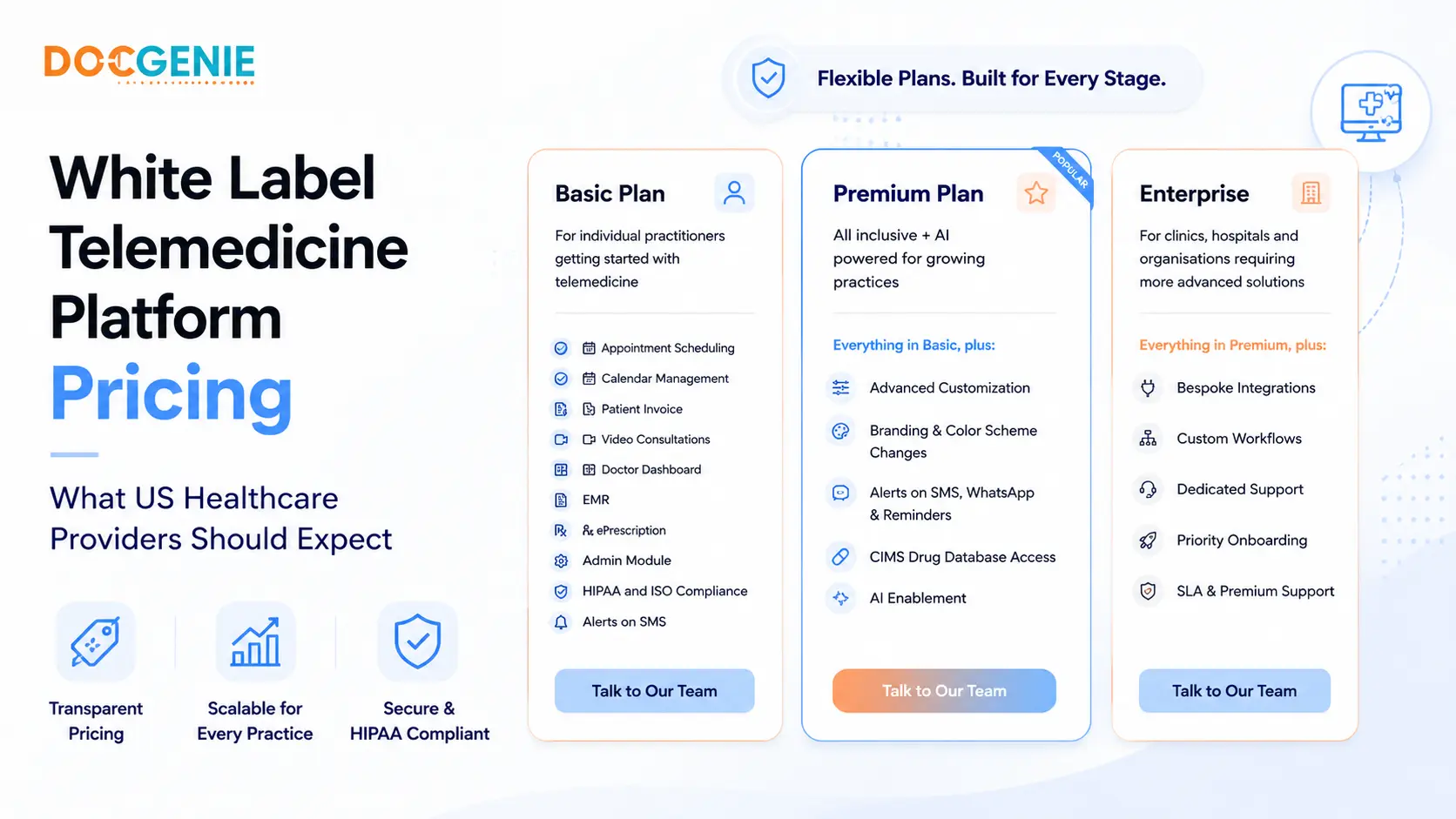
See DocGenie Global's pricing for indicative ranges relevant to your organisation size.
What Drives the Cost Up or Down
Several factors determine where your organisation falls in the pricing range:
How White Label Pricing Compares to Building In-House
Organisations evaluating whether to license a white label platform or build their own consistently underestimate the true cost of in-house development.
Building a HIPAA-aligned telemedicine platform from scratch typically involves:
A white label platform consolidates those costs into a predictable subscription. Most US healthcare organisations find that a white label platform is less expensive than in-house development over a 3-year comparison — and significantly faster to go live, typically in weeks rather than 12–18 months.
How to Think About Total Cost of Ownership
The right comparison is not "monthly platform fee versus nothing." It is "platform fee plus implementation versus in-house development plus ongoing engineering plus compliance plus infrastructure."
Framed that way, white label solutions are typically more cost-effective for organisations that are not primarily software companies. The hidden costs of in-house development — security patches, API maintenance, compliance updates, infrastructure scaling, staff turnover on the engineering team — accumulate over time and are routinely underestimated in initial business cases.
For white label platforms, the total cost of ownership calculation includes:
These are typically knowable upfront — which makes budgeting significantly more predictable than in-house development, where scope and timeline changes are the norm.
What to Define Before Requesting a Pricing Quote
Having clear answers to these questions before speaking with vendors will make pricing conversations faster and more accurate:
Vendors who give you a meaningful quote without these details are not quoting your actual requirements — they are giving you a range that may not reflect your situation.
What to Look for in a Telemedicine Platform Contract
Before signing a white label telemedicine contract, review these terms specifically:
Conclusion
White label telemedicine pricing is not designed to obscure cost — it is designed to reflect the significant variation in what different healthcare organisations actually need. A 3-provider mental health practice and a 200-provider hospital network have genuinely different requirements, and the same flat price would be unfair to one of them. The best approach is to define your requirements clearly, then request a tailored quote from vendors who can scope their pricing to what you actually need.
For context on what to compare when evaluating options, see our article on White Label Telemedicine vs. Building In-House and our overview of DocGenie Global platform features. US healthcare organisations can also see how pricing maps to a branded build on our white label telemedicine platform for US healthcare providers.
Frequently Asked Questions
What pricing models do white-label telemedicine platforms typically use?
White-label telemedicine platforms commonly use subscription-based pricing (monthly or annual), per-provider seat licensing, per-patient or per-consultation pricing, or custom enterprise contracts. Many vendors combine a base platform fee with variable charges for additional features, integrations, or support tiers.
What factors affect the total cost of a white-label telemedicine platform?
Key cost factors include the number of providers, patient volume, the depth of EHR/EMR integration required, the complexity of branding and customisation, the support level selected, data storage requirements, and whether features such as remote monitoring or AI tools are included.
Is white-label telemedicine significantly more affordable than building from scratch?
Yes, for most healthcare organisations. Building a compliant telemedicine platform from scratch typically involves significant upfront engineering investment, security review, compliance programme setup, and ongoing maintenance costs. White-label platforms distribute these costs across many customers, making the per-organisation cost substantially lower.
What is typically included in a white-label telemedicine subscription?
A standard subscription usually covers core platform features (scheduling, video, patient records, messaging), branded configuration, security and compliance infrastructure, platform updates, and a defined level of support. Additional integrations, custom development, and premium support may be priced separately.
How do I calculate the total cost of ownership for a telemedicine platform?
Total cost of ownership includes platform licensing fees, one-time implementation and configuration costs, integration development, staff training, ongoing support fees, and any per-transaction or per-provider charges. Comparing these against the cost of missed follow-ups, administrative inefficiency, and the time to launch gives a more complete ROI picture.