White Label Telemedicine vs. Building In-House: True Cost Comparison for US Healthcare Providers

Founder & Medical Director, DocGenie Global · MD (Family Medicine) · USC California · 30+ years of experience
Table of Contents
Introduction
For most US healthcare organisations, licensing a white label telemedicine platform for US clinics and hospitals is the faster, more cost-effective, and lower-risk path to branded virtual care than building in-house. The decision comes down to one question: is your core business delivering healthcare, or building software? For most providers, the answer shapes everything that follows.
What Building In-House Actually Involves
Building a HIPAA-aligned telemedicine platform from scratch is a software development programme, not a procurement project. Before a single patient logs in, your organisation needs to solve:
Conservative industry estimates for a basic but compliant telemedicine platform: 12 to 18 months of development and $500,000 to $2 million or more in initial engineering cost, depending on team size and integration scope. That timeline assumes you already have a technical team. If you are hiring one, add recruitment time and ramp-up. After launch, ongoing maintenance, security patches, compliance updates, and feature development continue to accrue cost indefinitely.
What a White Label Platform Provides Instead
A white label telemedicine platform gives you a pre-built, compliance-ready virtual care infrastructure that you configure around your brand and workflows — rather than building from the ground up.
With a white label platform, US healthcare organisations get:
The build-versus-buy comparison is not just about upfront cost. It is about where your organisation's capacity and attention go over the long term.
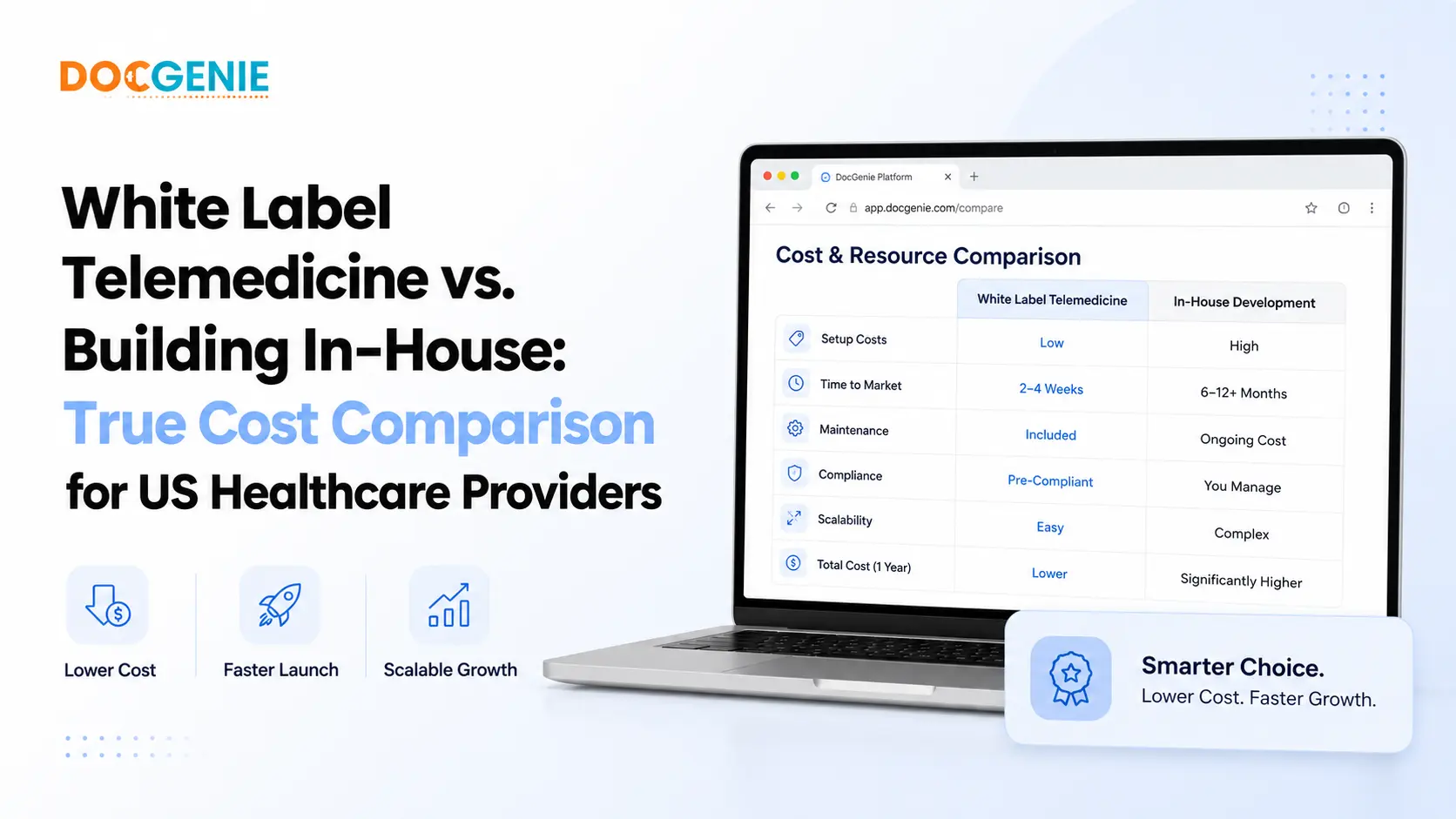
True Cost Comparison: White Label vs. In-House
The cost comparison needs to look beyond the initial build to total cost of ownership over three to five years:
Time to launch: In-house development typically takes 12–18+ months before any patient sees a provider. A white label platform typically launches in weeks, depending on branding scope, integration complexity, and configuration requirements.
Initial investment: In-house development carries $500K–$2M+ in upfront engineering cost. White label platforms use subscription or per-provider licence pricing — a predictable recurring cost rather than a large capital outlay.
Compliance setup and maintenance: In-house means your team owns all HIPAA compliance obligations — policies, audits, incident response, documentation. White label platforms have compliance-supporting architecture already built; vendors maintain it as regulations evolve.
Ongoing engineering: In-house requires a dedicated internal engineering team to maintain the platform, handle security patches, and build new features. White label maintenance is vendor-managed and included in the subscription.
Feature updates: In-house features require scoping, prioritisation, and custom development — competing for resources against clinical and operational priorities. White label platforms include ongoing improvements in the platform roadmap.
Brand ownership: Both models can give you full brand ownership — your logo, domain, and patient portal. A white label platform just delivers it without the engineering investment.
When Building In-House Makes Sense
In-house development is worth evaluating if your organisation meets several specific criteria:
For most US clinics, hospitals, specialty practices, and digital health companies, that description does not apply. The organisations that successfully build telemedicine platforms in-house are typically large health systems with existing engineering departments or well-funded digital health startups with technical co-founders.
The White Label Advantage for US Providers
The US healthcare market moves fast. Patient expectations for digital care experiences have shifted significantly. A white label platform lets you enter the virtual care market under your own brand while your competitors are still writing software specifications. DocGenie Global's white label telemedicine platform is designed for US healthcare providers who want a branded, HIPAA-aligned virtual care experience without the cost, complexity, and time of in-house development. See our step-by-step guide: How to Launch a White Label Telemedicine Platform.
Conclusion
For the majority of US healthcare organisations — clinics, specialty practices, hospitals, and digital health companies — a white label telemedicine platform is the faster, more cost-effective, and lower-risk path to branded virtual care. The build-vs-buy decision ultimately comes down to one thing: whether building and maintaining healthcare software is a core competency your organisation has, or wants to develop. For most providers, it is not — and a white label platform is the more rational choice.
If your organisation operates in the United States, our US white label telemedicine platform outlines how a branded, HIPAA-aligned build works for American clinics, hospitals, and digital health companies.
Frequently Asked Questions
What is white-label telemedicine software?
White-label telemedicine software is a pre-built virtual care platform that healthcare organisations can brand and configure as their own. Rather than building a telemedicine system from scratch, providers license an existing platform, add their logo, domain, and workflows, and launch under their own brand identity.
Why do US healthcare providers choose white-label telemedicine over building in-house?
White-label telemedicine offers a faster path to launch, lower upfront investment, and built-in compliance architecture. Building in-house typically requires 12–18 months of development, a dedicated engineering team, ongoing security reviews, and continuous maintenance — costs and timelines that are not practical for most clinics or health systems.
How long does it take to launch a white-label telemedicine platform?
With the right vendor, a white-label telemedicine platform can typically be configured and launched in weeks rather than months. The exact timeline depends on branding requirements, EHR integration complexity, staff training, and compliance review.
What does a white-label telemedicine platform include for US providers?
A white-label telemedicine platform typically includes patient registration, appointment scheduling, secure video consultations, EMR/EHR integration support, e-prescriptions, digital payments, patient dashboards, admin reporting, and a branded patient portal under the provider's own domain.
Can we fully brand a white-label telemedicine platform as our own?
Yes. White-label platforms are designed so that patients interact entirely with the provider's brand — the logo, color scheme, domain name, and communication templates all reflect the healthcare organisation, not the underlying technology vendor.
Related Articles