
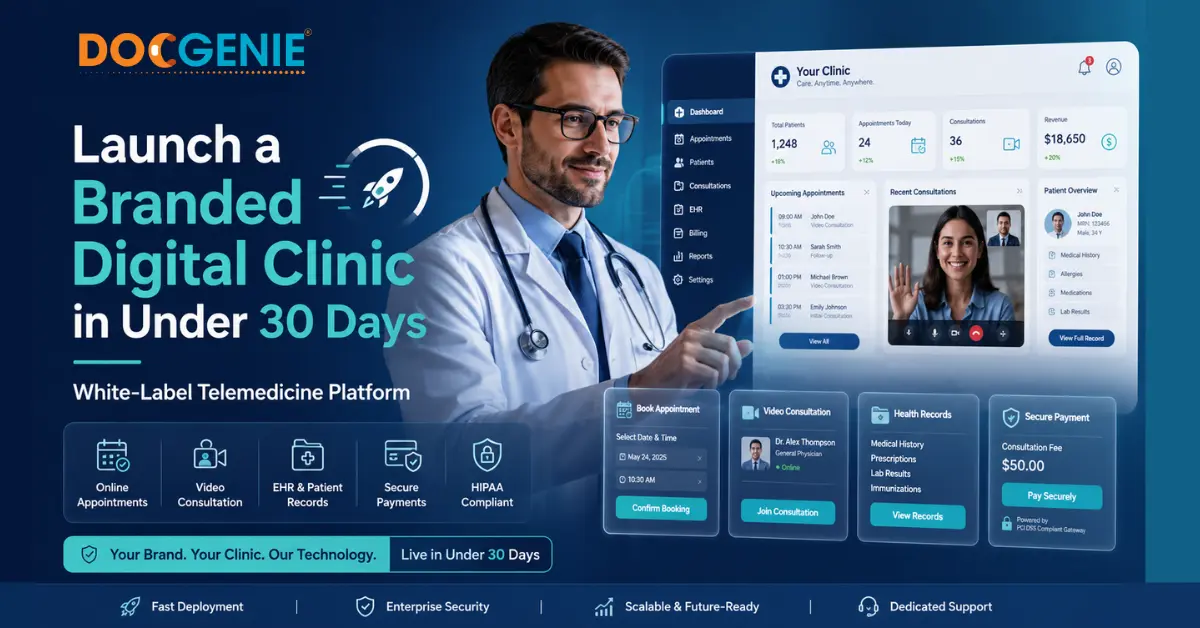
Launch a Branded Digital Clinic in 30 Days | DocGenie Global
Table of Contents
Introduction
Virtual care is no longer a secondary service for healthcare providers. It is becoming a core part of how clinics, hospitals, independent practitioners, and healthcare businesses deliver accessible, efficient, and patient-first care.
For many healthcare organizations, the challenge is no longer whether they should offer virtual care. The real question is how quickly they can launch it without increasing operational complexity, compromising patient data security, or losing control of their brand experience.
The good news is that launching a fully branded digital clinic no longer requires months of IT development, a large engineering team, or a heavy upfront technology investment. With the right white-label telemedicine platform, healthcare providers can go live in weeks with their own branding, workflows, patient journey, and digital care infrastructure in place.
Why Clinics and Hospitals Need a Branded Digital Clinic Today
A branded digital clinic gives healthcare providers more than just the ability to offer online consultations. It creates a complete virtual care environment where patients can discover services, book appointments, consult doctors, receive prescriptions, access records, make payments, and stay connected with their care team.
For clinics and hospitals, this can improve both patient experience and operational efficiency.
Patient expectations have changed significantly. People now expect healthcare to be accessible, convenient, and digitally enabled. They want the ability to consult a doctor without unnecessary travel, waiting-room delays, or repeated phone calls for appointment coordination.
For healthcare providers, virtual care can support:
A branded digital clinic also helps healthcare organizations protect their identity. Instead of sending patients to a third-party platform with unfamiliar branding, clinics can deliver virtual care under their own name, logo, domain, and patient experience.
This is especially important for clinics, hospitals, specialty care groups, and healthcare networks that want to build long-term patient trust.
The Problem with Fragmented Telemedicine Tools
Many healthcare providers begin their digital journey by using separate tools for different functions. One tool for video consultations. Another for appointment booking. Another for payments. Another for patient communication. Another for medical records.
At first, this approach may seem practical. In reality, it often creates operational problems that grow over time.
Disconnected systems force staff to move between multiple platforms, manually update records, reconcile payment information, and troubleshoot patient issues across different tools. This slows down daily operations and increases the risk of errors.
Fragmentation can also affect the quality of care. When consultation notes, prescriptions, appointment history, and patient communication are spread across different systems, doctors may not have a complete view of the patient journey. For patients with chronic conditions, ongoing treatment plans, or complex care needs, this can directly affect continuity of care.
There is also a serious security concern. Every additional platform, integration, and data transfer point can introduce new risk. Patient data needs consistent protection across the entire digital care journey. When multiple vendors are involved, each with different security standards and access controls, maintaining a strong compliance posture becomes more difficult.
A modern digital clinic should not feel like a patchwork of disconnected tools. It should operate as one secure, centralized, end-to-end virtual care platform.
What Is a White-Label Telemedicine Platform?
A white-label telemedicine platform allows healthcare providers to launch digital healthcare services under their own brand, without building the technology from scratch.
Instead of investing months into software development, compliance planning, testing, and integrations, clinics and healthcare organizations can use a ready virtual care platform that is customized with their brand identity and workflows.
A strong white-label telemedicine platform typically includes:
The biggest advantage is speed. A healthcare organization can launch faster while still offering a branded, professional, and secure patient experience.
How to Launch a Branded Digital Clinic in Under 30 Days
Launching a branded digital clinic quickly requires more than choosing software. It requires a clear strategy, defined workflows, the right implementation partner, and a platform built specifically for healthcare delivery.
Here is a practical step-by-step approach.
Step 1: Define Your Digital Clinic Requirements
The most common reason digital clinic launches get delayed is not technology. It is lack of clarity.
Before choosing a platform, your leadership team should define what your digital clinic needs to achieve.
Start with your brand requirements. Decide how the platform should look and feel for patients. This includes your logo, color palette, custom domain, communication tone, and overall patient experience.
Next, define your clinical workflows. Will you offer general consultations, specialist care, chronic care management, follow-up visits, second opinions, or a combination of services? Different care models may require different workflows.
You should also clarify how patients will communicate with your team before and after consultations. This may include appointment reminders, automated notifications, follow-up messages, prescription updates, or care instructions.
If you already use existing systems such as EMRs, payment gateways, laboratory partners, pharmacy networks, or hospital management software, identify which integrations are required.
Finally, consider your regulatory environment. Healthcare data protection, consent management, audit trails, and data residency requirements can vary by geography. These must be addressed before launch.
Step 2: Choose the Right White-Label Telemedicine Platform
Not every telemedicine platform is built for healthcare organizations that want to scale. Some tools are designed only for basic video consultations, while others offer complete virtual care infrastructure.
When evaluating a platform, look for healthcare-first capabilities.
The platform should support end-to-end workflows, not just online appointments. It should help manage the full patient journey from registration to consultation, prescription, payment, documentation, and follow-up.
Security and compliance should be non-negotiable. A credible platform should provide clear information about its data protection standards, access controls, audit trails, encryption, and relevant security certifications.
It is also important to assess whether the platform has been designed with input from healthcare professionals. Clinical workflows are different from generic SaaS workflows. Doctors, nurses, administrators, and patients all interact with the system differently. A healthcare-first platform should reflect those real-world needs.
You should also evaluate the vendor’s implementation support. A strong technology partner should not simply hand over software. They should help configure workflows, support onboarding, guide testing, and remain available after launch.
Step 3: Customize the Platform Around Your Brand
A branded digital clinic should feel like an extension of your existing healthcare organization.
This means your patients should see your brand throughout the experience, including the login page, appointment booking flow, consultation interface, reminders, emails, payment experience, and post-consultation communication.
Branding is not only visual. It also includes the way patients are guided through the journey. The platform should reflect your tone, your service model, and your standards of care.
For clinics and hospitals, this matters because trust is central to healthcare. Patients are more likely to engage with a digital service when it feels familiar, secure, and connected to the provider they already know.
Step 4: Configure Clinical and Administrative Workflows
Once the branding is finalized, the next step is workflow configuration.
This includes setting up doctor profiles, service categories, consultation types, appointment durations, availability, pricing, payment rules, prescription workflows, EMR templates, and follow-up processes.
Administrative workflows should also be configured carefully. Your staff should know how to manage appointment requests, reschedule consultations, verify payments, assist patients, and access required records.
The goal is to make the digital clinic easy for both patients and providers. If the workflow is complicated, adoption will suffer.
Step 5: Train Doctors, Staff, and Admin Teams
A successful digital clinic launch depends on user adoption.
Doctors should be comfortable using the consultation interface, reviewing patient details, writing notes, issuing e-prescriptions, and completing post-consultation documentation.
Administrative staff should be trained on appointment management, patient support, payment coordination, and basic troubleshooting.
Your internal team should also understand the patient journey from start to finish. This helps them guide patients confidently and resolve issues quickly.
Training does not need to be complicated, but it must be practical. The best approach is to use real workflow examples that mirror daily clinic operations.
Step 6: Run a Structured Soft Launch
A soft launch is one of the most important steps before going live fully.
Instead of opening the platform to all patients immediately, start with a small group of doctors, staff, and selected patients. Use this phase to test the complete digital care journey.
During the soft launch, review:
Collect feedback from both patients and providers. Look for friction points, delays, confusion, or missed communication.
A soft launch helps you fix issues early, before they affect a larger patient base.
Step 7: Go Live and Promote Your Digital Clinic
Once the platform has been tested, you can launch it to your broader patient base.
Your go-live strategy should include both internal and external communication.
Internally, make sure doctors, front-desk teams, call center staff, and administrators know how to explain the service to patients.
Externally, promote your branded digital clinic across your website, Google Business Profile, email lists, social media, WhatsApp channels, and patient communication touchpoints.
Your messaging should clearly explain:
A digital clinic should not be treated as a hidden feature. It should be promoted as a major patient convenience and care access advantage.
Features to Look for in a Virtual Care Platform
The right platform can help you launch faster, operate more efficiently, and scale with confidence.
Here are the most important features to look for.
End-to-End Workflow Coverage
A strong digital clinic platform should manage the complete care journey in one place. This includes patient registration, doctor onboarding, appointment scheduling, calendar management, EMRs, e-prescriptions, video consultations, payments, and follow-up communication.
This reduces the need for multiple disconnected tools and helps your team work from a single system.
White-Label Branding
Your digital clinic should carry your brand identity, not someone else’s. Look for a platform that supports your logo, colors, custom domain, branded patient experience, and communication style.
This helps build trust and keeps the patient relationship connected to your organization.
Secure Patient Data Management
Healthcare platforms must be designed with strong data protection. Look for role-based access control, encryption, secure hosting, audit logs, consent workflows, and recognized security certifications.
Security should not be an afterthought. It should be part of the platform’s foundation.
EMR and E-Prescription Capabilities
Doctors need access to structured patient information during and after consultations. A platform with EMRs and e-prescription support helps maintain better documentation, continuity of care, and clinical efficiency.
Integrated Payments
Payment collection should be smooth and connected to the consultation workflow. Integrated payments reduce manual coordination and make the process easier for both staff and patients.
Modular and API-First Architecture
Your requirements today may not be the same as your requirements in the future. Choose a platform that can integrate with other systems such as labs, pharmacies, insurance partners, wearable devices, or existing EMRs.
A modular architecture allows your digital clinic to evolve as your business grows.
Multi-Device Compatibility
Patients may consult from a mobile phone, while doctors may use a desktop or tablet. The platform should work smoothly across devices and browsers to support real-world usage.
Reliable Vendor Support
Technology alone is not enough. Your vendor should offer responsive support during implementation and after launch. Ask about support timelines, escalation processes, training, and future product updates before making a decision.
How DocGenie Global Helps You Launch a Branded Digital Clinic in Weeks
DocGenie Global helps healthcare providers, clinic groups, hospitals, and healthcare ecosystem partners launch secure, branded virtual care platforms without building technology from scratch.
DocGenie is an end-to-end white-label telemedicine platform built specifically for healthcare delivery. It allows organizations to create their own branded digital clinic with customized workflows, patient journeys, and operational processes.
With DocGenie Global, healthcare organizations can launch a virtual care platform that includes:
DocGenie Global’s platform is HIPAA-compliant, SOC 2 Certified, and ISO/IEC 27001:2022 Certified, with 99.9% uptime, as stated in the provided company content.
The platform is designed to support healthcare providers that want to move quickly without compromising on security, scalability, or patient experience.
Whether you are a private clinic group consolidating digital operations, a hospital expanding virtual care services, or a healthcare vendor building a telehealth offering for clients, DocGenie Global provides the infrastructure to help you launch faster and operate with confidence.
Conclusion
Launching a branded digital clinic is no longer a long, complex, and expensive technology project. With the right white-label telemedicine platform, healthcare organizations can move from planning to launch in weeks while maintaining control over their brand, workflows, and patient experience.
The key is to avoid fragmented tools and choose a platform that brings virtual care, clinical workflows, patient communication, payments, and security into one connected system.
For healthcare providers ready to expand digital care, improve operational efficiency, and deliver a modern patient experience, a branded digital clinic is no longer optional. It is a strategic growth opportunity.
Talk to DocGenie Global’s team to explore how quickly your clinic, hospital, or healthcare network can go live.
Frequently Asked Questions
What is a branded digital clinic?
A branded digital clinic is a virtual healthcare setup that allows a clinic, hospital, or healthcare organization to offer online consultations and digital care services under its own brand identity. It can include appointment booking, video consultations, EMRs, e-prescriptions, payments, reminders, and patient communication.
How long does it take to launch a branded digital clinic?
With a ready white-label telemedicine platform, a branded digital clinic can often be launched in a few weeks. The exact timeline depends on branding requirements, workflow complexity, integrations, training, and compliance needs.
Why should clinics choose a white-label telemedicine platform instead of building from scratch?
A white-label telemedicine platform helps clinics launch faster, reduce development costs, avoid technical complexity, and start with healthcare-ready workflows. It also allows providers to maintain their own brand identity while using proven technology infrastructure.
What features should a digital clinic platform include?
A digital clinic platform should include patient registration, doctor onboarding, appointment scheduling, video consultations, EMRs, e-prescriptions, integrated payments, patient communication, admin dashboards, security controls, and reporting tools.
Is a branded digital clinic useful for hospitals and healthcare networks?
Yes. Hospitals and healthcare networks can use branded digital clinics to expand access, manage follow-up care, support specialist consultations, improve patient engagement, and create a more connected virtual care experience.
How does DocGenie Global support digital clinic launches?
DocGenie Global provides an end-to-end white-label telemedicine platform with branding, virtual care workflows, EMRs, e-prescriptions, HD video consultations, payments, API-first integrations, security compliance, and implementation support.
Ready to enhance your telehealth services?
Discover how DocGenie Global can help you deliver superior virtual care experiences to your patients.