
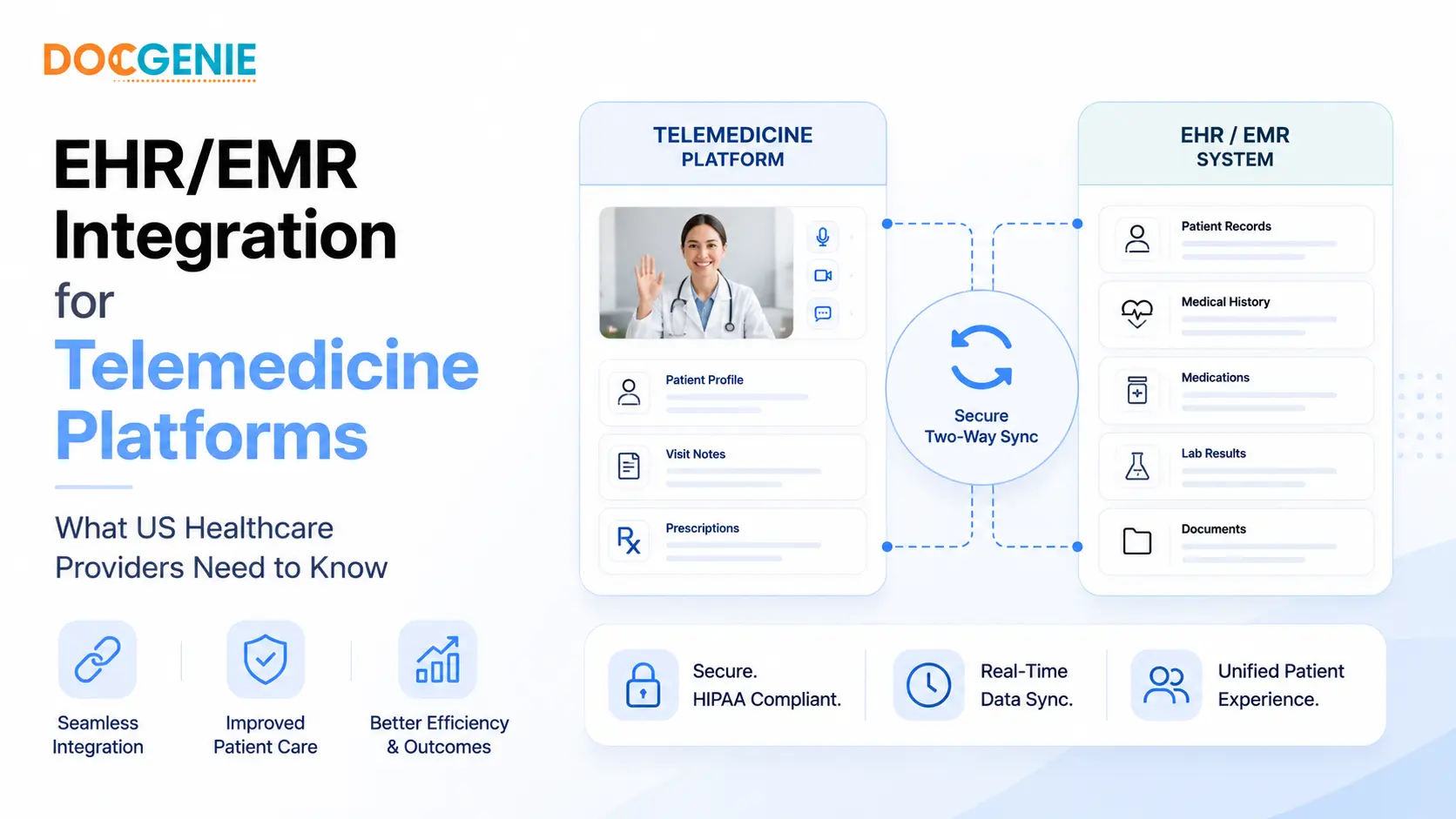
EHR and EMR Integration for Telemedicine: What US Healthcare Providers Need to Know

Founder & Medical Director, DocGenie Global · MD (Family Medicine) · USC California · 30+ years of experience
Table of Contents
Introduction
EHR and EMR integration connects your telemedicine platform to your existing clinical records system — so patient history is available before a virtual consultation and consultation notes flow back into the patient record automatically after. For US healthcare providers evaluating white label telemedicine platforms for US providers, understanding what integration actually involves, what it enables, and how to evaluate vendor capability prevents the most common implementation delays.
EHR vs. EMR: A Practical Clarification
These terms are used interchangeably in most vendor conversations, but there is a technical distinction:
EMR (Electronic Medical Record) systems are digital versions of a patient chart, typically used within a single practice or clinic. They capture clinical data but are not designed for easy sharing across organisations.
EHR (Electronic Health Record) systems are designed to share information across multiple providers and care settings. Major US EHR platforms — including Epic, Cerner, athenahealth, eClinicalWorks, and Allscripts — are designed with interoperability in mind.
For telemedicine integration purposes, what matters is what APIs or integration methods your existing system exposes, and whether the telemedicine vendor has experience connecting to it. Whether your system is technically an EMR or EHR is less important than whether the data can flow between it and your virtual care platform.
What EHR/EMR Integration Actually Enables
When your telemedicine platform is connected to your clinical records system, it can:
Without integration, virtual consultations exist in a separate system from the rest of the patient record — creating clinical risk, administrative inefficiency, and a fragmented view of the patient's care history.
What Integration Actually Looks Like Technically
Most modern EHR and EMR systems expose APIs (Application Programming Interfaces) that allow external platforms to read and write data in structured formats.
HL7 FHIR (Fast Healthcare Interoperability Resources) is the current US standard for health data exchange, supported by Epic, Cerner, athenahealth, eClinicalWorks, and Allscripts. The 21st Century Cures Act requires most EHR vendors to expose FHIR APIs — which means the majority of US clinical systems now have a standardised integration pathway.
Integration depth varies significantly:
Most telemedicine deployments start at basic or mid-level integration and expand as the virtual care programme matures.
Questions to Ask Your Telemedicine Vendor About EHR/EMR Integration
Ask these questions directly — not during a sales call, but in a technical discovery session with the vendor's implementation team:
Common EHR/EMR Integration Pitfalls to Avoid
Several integration mistakes add cost and delay to telemedicine deployments:
How to Plan Your Integration Scope Before Vendor Selection
Define your integration requirements before you begin evaluating telemedicine vendors. This allows you to compare vendors against specific, consistent criteria rather than general claims.
Minimum information to define upfront:
Providers who define this before entering vendor conversations move through the selection process faster and avoid discovering integration limitations after a contract is signed.
Conclusion
EHR and EMR integration is what turns a telemedicine platform from a standalone video tool into a genuine extension of your clinical workflow. The providers who get the most value from white label telemedicine are those who define their integration requirements clearly upfront, ask the right questions of their vendor, and plan for ongoing maintenance — not just the initial go-live. If you are evaluating platforms, see our guide on 5 Key Features to Look For in a White Label Telemedicine Platform for a broader evaluation framework. US providers can also explore our US white label telemedicine platform and how it supports EHR/EMR-connected workflows.
Frequently Asked Questions
What is the difference between EHR and EMR integration for telemedicine?
An EMR (Electronic Medical Record) is typically a digital chart used within a single practice. An EHR (Electronic Health Record) is designed to share patient information across multiple providers and care settings. For telemedicine integration purposes, what matters most is how your existing system stores data and which APIs or standards it supports for data exchange.
What is HL7 FHIR and why does it matter for telemedicine integration?
HL7 FHIR (Fast Healthcare Interoperability Resources) is the current US standard for health data exchange between software systems. It defines how patient data is structured and transmitted via APIs. Many major US EHR systems support FHIR, which simplifies integration with telemedicine platforms. The 21st Century Cures Act also requires certified EHR systems to support FHIR-based APIs.
What data can flow between an EHR and a telemedicine platform?
Integration can enable bi-directional data exchange including patient demographics, appointment data, medical history, consultation notes, diagnosis codes, prescriptions, lab results, referrals, and follow-up instructions. The depth of data flow depends on the integration level and the APIs available in each system.
Who is responsible for maintaining EHR/EMR integration after go-live?
This is a critical question to clarify with your telemedicine vendor before launch. Responsibilities for monitoring, updating, and troubleshooting the integration as either system updates its API should be defined in your vendor agreement. Ambiguity here is a common source of integration failures post-launch.
How long does EHR/EMR integration take for a telemedicine platform?
Basic integrations such as appointment sync and patient look-up can often be completed in weeks. Deeper bi-directional integrations with complex field mapping, clinical decision support triggers, or pharmacy routing can take months depending on the systems involved and the availability of APIs from the EHR vendor.